
Education City Mosque (Minaretein)
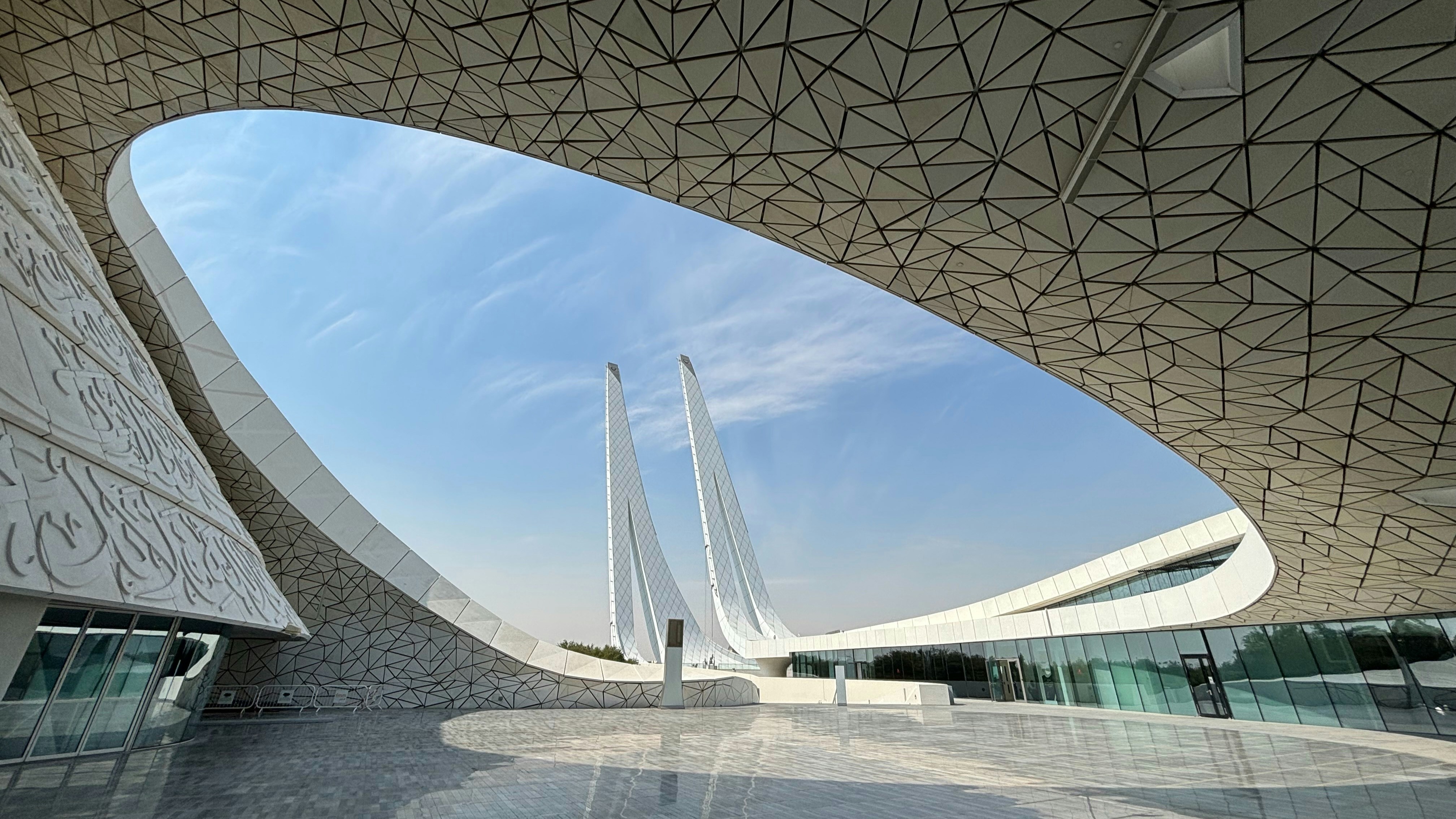
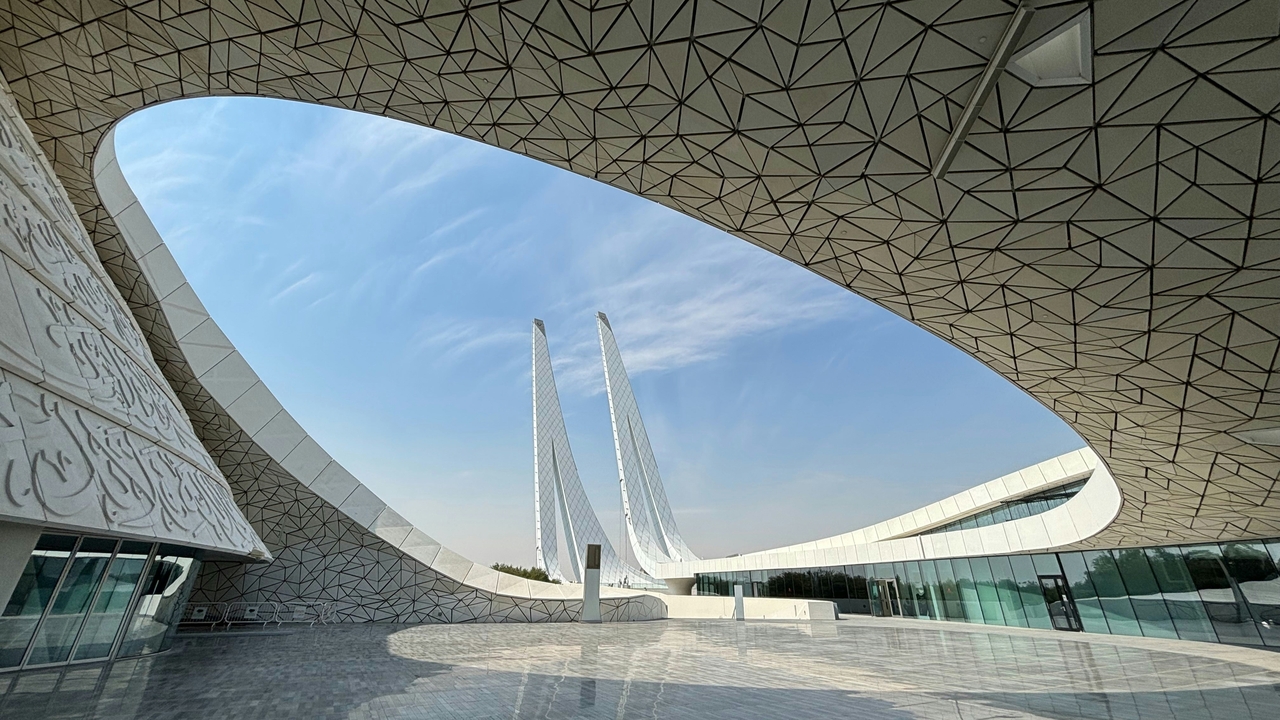
Nothing else in Doha looks quite like it. Two slender minarets climb 90 metres into the sky, their surfaces written top to bottom in Arabic calligraphy, and beneath them the entire mosque is lifted clear of the ground on five vast pillars.
This is the Education City Mosque, known as Minaretein, which means the two minarets in Arabic. It sits within the Minaretein building at the heart of Hamad Bin Khalifa University's College of Islamic Studies, in Education City on the Al Rayyan side of Doha.
Completed in 2013 by the architects Mangera Yvars, it was designed as a building about ideas as much as worship. The five pillars that raise it stand for the Five Pillars of Islam, the two minarets for knowledge and light, and the whole structure is built around the belief that faith and learning are inseparable.
It is a working community mosque, and it welcomes visitors of all backgrounds. Around it lie a Qur'anic garden, streams representing the rivers of Paradise, and one of Doha's most walkable modern districts.
Free to visit, endlessly photogenic, and unlike any mosque you have seen. Come for the architecture and stay for the idea behind it.
Why the Education City Mosque Matters
Doha has grander and older mosques, but none makes an argument the way this one does. Minaretein is a piece of architecture built to say something, and that is what sets it apart.
Its whole design is a statement about the compatibility of Islam and modern learning. The mosque is raised on five great pillars representing the Five Pillars of Islam, each inscribed with Qur'anic verse, and the shaded undercroft beneath them leads students up into the prayer hall. Two minarets rise 90 metres and point towards Makkah, standing for knowledge and light. The building spirals from classrooms and library into the sacred space at its core, embodying the idea that all knowledge ultimately flows from faith.
It is also internationally acclaimed. The building won Best Religious Building at the World Architecture Festival in 2015, was nominated for the Royal Institute of British Architects' inaugural international prize in 2016, and took American Architecture Prize honours in 2017. Few modern mosques anywhere have been recognised on this scale.
And it lives up to its billing as more than a mosque. It hosts lectures, events and community activities, houses the College of Islamic Studies and its library, and sits within Education City, making it a natural anchor for a day exploring Qatar's most forward looking district.
Known for: Its two 90-metre calligraphy minarets and a prayer hall raised on the Five Pillars of Islam
Also called: Minaretein, meaning the two minarets, and the QFIS Mosque
Architects: Mangera Yvars, completed in 2013, with minaret calligraphy by Iraqi artist Taha al-Hiti
Setting: The Minaretein building at Hamad Bin Khalifa University, Education City, Al Rayyan
Capacity: Around 1,800 worshippers in the main hall and 1,000 more in the courtyard
Status: A working community mosque, free to visit and open to all backgrounds
A Mosque Built on Meaning
The building rewards knowing what you are looking at, because almost every element carries an idea.
The most immediate feature is the way the mosque floats. Rather than sitting on the ground, the prayer hall is lifted on five massive pillars, each standing for one of the Five Pillars of Islam, Shahada, Salah, Zakat, Sawm and Hajj, and inscribed with verses from the Qur'an. The shaded space they create beneath the hall forms a cool undercroft that draws visitors and students up into the mosque.
Then there are the minarets that give the building its name. Two towers climb 90 metres, their surfaces covered in vertical Arabic calligraphy designed by the Iraqi architect and calligrapher Taha al-Hiti, script that sweeps the eye upward and, at the top, points towards Makkah. Inside, the same care continues, with mashrabiya screens and calligraphy filtering natural light across a serene, suspended prayer hall.
Water and greenery complete the scheme. Four streams flow from the building towards a central garden, representing the four rivers of Paradise described in the Qur'an, and the complex includes the Qur'anic Botanic Garden, planted with species mentioned in the Qur'an alongside Qatar's native flora. It is architecture designed to be read, not just admired.
Inside and Around the Mosque
There is no single fixed route, and the building flows between learning and worship. These are the parts worth noticing.
The Five Pillars and the Undercroft
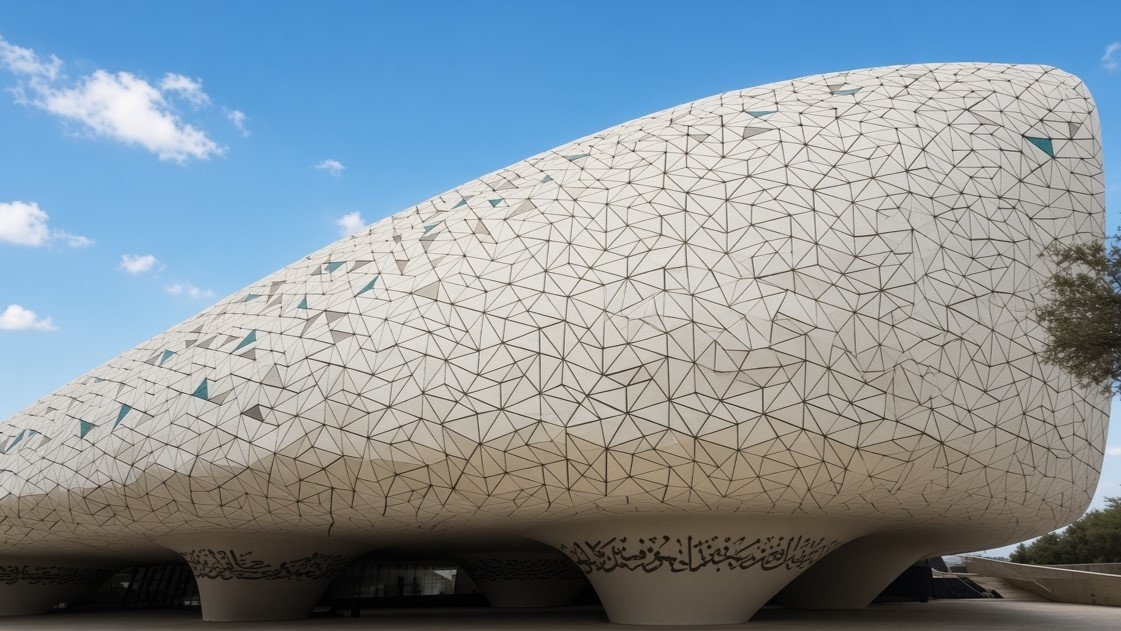
Start beneath the mosque. The five great pillars that raise the prayer hall are the heart of the design, each representing a pillar of Islam and carrying Qur'anic inscription. The shaded undercroft they form is a striking space in its own right and the route up into the mosque.
The Two Minarets
The building's signature. Two 90-metre towers wrapped in vertical calligraphy, best appreciated from a short distance where you can take in their full height and the way the script draws your eye skyward. They are especially dramatic against a clear sky or when lit after dark.
The Prayer Hall
A calm, suspended hall finished with mashrabiya screens and calligraphy, where natural light does much of the work. It seats around 1,800 worshippers, with room for a further 1,000 in the courtyard outside, and its restraint is a deliberate contrast to the bold structure that holds it up.
The Rivers of Paradise and Qur'anic Botanic Garden
Outside, four streams represent the four rivers of Paradise, feeding a garden at the centre of the complex. Nearby, the Qur'anic Botanic Garden gathers plants named in the Qur'an together with native Qatari species, a quiet, meaningful space that rewards a slow wander.
The College of Islamic Studies
The Minaretein building also houses Hamad Bin Khalifa University's College of Islamic Studies and its library, part of the mosque's purpose as a centre for learning and debate as much as prayer. Its programme of lectures and events is part of what keeps the building active.
Visiting Respectfully
The Education City Mosque is welcoming and used to visitors, but it remains an active place of worship and part of a working university, so a few courtesies apply.
Visit outside prayer times, since access for visitors pauses during the five daily prayers and around Friday prayers in particular. Dress modestly, covering shoulders, arms and legs, with women covering their hair inside the prayer areas. Remove your shoes before entering the prayer hall, keep quiet and unobtrusive inside, and be considerate around worshippers and students.
Photography of the exterior is one of the main draws and is generally welcomed, but check before photographing inside, especially during prayer, and never photograph people while they are praying. As arrangements can vary on a university campus, it is worth confirming current visiting access before a special trip.
Visitor Essentials
Opening hours: Open to visitors outside the five daily prayer times, with access paused for prayers and around Friday midday. Timings follow the prayer schedule, so plan around them.
Admission: Free for everyone, and visitors of all backgrounds are welcome.
Time needed: Around 45 minutes to an hour for the mosque and gardens, longer combined with the rest of Education City.
Dress: Modest dress covering shoulders, arms and legs, with hair covered for women inside the prayer areas.
Etiquette: Remove shoes before entering the prayer hall, keep quiet inside, and respect worshippers and students.
Photography: Exterior photography welcomed. Check before photographing inside, and never photograph worshippers.
Facilities: Prayer and ablution areas, the Qur'anic Botanic Garden, the College of Islamic Studies library, and outdoor parking. Full Education City facilities are close by.
Good to know: The building is best photographed from a short distance, where both 90-metre minarets and the raised prayer hall fit the frame.
Getting Here
Metro: The Doha Metro Green Line to Qatar National Library station is the closest stop, from which the mosque is a short ride or walk across the Education City campus.
Tram: Education City runs its own tram network across the campus, which is the easiest way to cover the last stretch and reach nearby sights.
Taxi: Straightforward and direct. Around 25 to 30 minutes from Hamad International Airport and 15 to 20 minutes from West Bay.
Car: The mosque has dedicated outdoor parking, which makes driving simple, and Education City is easy to navigate by car.
Make a Half Day of It
The Education City Mosque is best enjoyed as part of a wider half day exploring Education City, one of the greenest and most walkable districts in Doha.
See the mosque first, taking in the minarets and the raised prayer hall, then walk or take the campus tram to Qatar National Library, the extraordinary Rem Koolhaas designed building a short distance away, which anyone can enter. Mathaf, the Arab Museum of Modern Art, is also close by and free to visit.
If you have longer, Oxygen Park is ideal for a walk in the cooler months, and Al Shaqab, Qatar's Arabian horse and equestrian centre, can be arranged in advance. Late afternoon suits the mosque best, when the light softens on the minarets, and the building looks its most dramatic floodlit after dark.
Sitting on the Al Rayyan side of the city, Education City pairs easily with a return into central Doha for dinner, giving you two very different faces of Qatar in one day.
Stay Nearby
There is no accommodation at the mosque itself, and Education City has limited hotels, so most visitors treat it as a half day trip from a base in the city.
West Bay is the practical choice, around 15 to 20 minutes away, with the skyline, the Corniche and plenty of dining and hotels. The Msheireb and Souq Waqif area also connects to Education City on the same metro line, making the trip out simple while keeping the old city within reach.
Check availability and rates for hotels near Education City on Booking.com. (Booking.com affiliate link, rel="sponsored nofollow noopener", target="_blank")
Nearby Places to Visit
Qatar National Library: A short ride away. A Rem Koolhaas designed landmark open to all, with a sunken heritage collection.
Mathaf, Arab Museum of Modern Art: In Education City and free to enter, holding the world's largest collection of modern Arab art.
Oxygen Park: Landscaped walking and running paths across the campus, best in the cooler months.
Al Shaqab: Qatar's Arabian horse breeding and equestrian centre, visitable by arrangement.
Education City Stadium: A 2022 World Cup venue on the edge of the campus.
Villaggio Mall: A short drive away, one of Doha's largest malls, near the Aspire Zone.
Frequently Asked Questions
Explore Tours
No tours found right now.