Mathaf: Arab Museum of Modern Art
Discover the Mathaf: Arab Museum of Modern Art
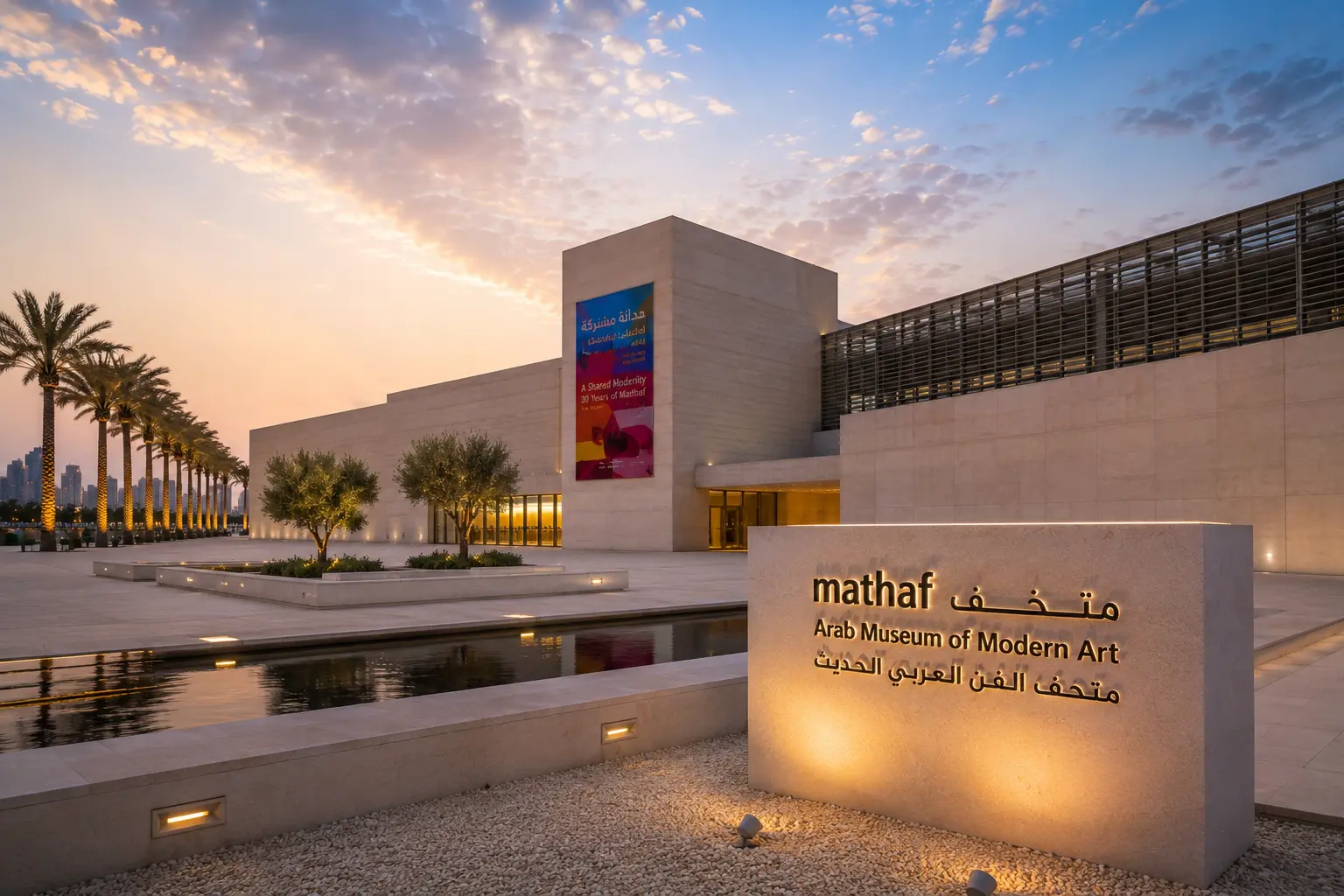
Out in Education City, past the university campuses and the tree lined avenues, a low white building sits quietly behind a sculpture garden. There are no turrets, no desert rose, no island in the bay. From the outside it looks like what it once was, a school.
Inside is something no other museum in the world has. Mathaf holds the largest collection of modern and contemporary Arab art anywhere, more than 9,000 works spanning from the 1840s to the present day, and it is the only museum built specifically to tell that story.
The name simply means museum in Arabic, and the collection began as one man's. Sheikh Hassan bin Mohammed bin Ali Al Thani spent around three decades buying the work of Arab artists at a time when few institutions anywhere were paying attention. What he assembled became the foundation of a national museum when Mathaf opened in 2010.
What you get is a hundred and eighty years of the Arab world seen through its own painters, sculptors and photographers. Independence movements, exile, cities changing beyond recognition, faith, family, war. It is the most human of Doha's museums, and the least visited.
Entry is free for everyone. Give it two hours.
Why Mathaf Matters
Every major museum tells you about the past. Mathaf tells you what the Arab world has been thinking for the last century and a half, in its own voice.
That gap was real before this museum existed. Modern Arab art had no dedicated institution anywhere, no permanent home, no organising history. Works by significant twentieth century painters from Egypt, Iraq, Syria, Palestine, Lebanon and the Gulf were scattered across private hands and rarely exhibited together. Mathaf changed that, and in doing so gave a whole region's modern art movement a centre.
The collection reaches beyond the Arab countries themselves to artists from Africa, Asia and Europe whose work connects to the Arabian peninsula, which is what makes the galleries feel wider than a national survey.
The museum is also an active research institution rather than a display case. It runs an on site library, a free bilingual online encyclopedia of modern Arab art used by scholars worldwide, artist residencies, student competitions and a full programme of talks and workshops. If Doha's other museums are about heritage, this is where the city thinks about the present.
Known for: The world's largest collection of modern and contemporary Arab art
Collection: More than 9,000 works spanning the 1840s to the present day
Founded: 2010, built around the collection of Sheikh Hassan bin Mohammed bin Ali Al Thani
Building: A former school reimagined by French architect Jean-François Bodin
Status: Free to enter, and the most overlooked major museum in Doha
A School Turned Inside Out
Mathaf did not get a landmark building, and it has quietly benefited from that.
The French architect Jean-François Bodin, known for his work on European museums, took an existing school in Education City and stripped it back into gallery space. What emerged is deliberately plain: white walls, natural light, clean lines and rooms at a human scale, with the original structure still legible if you look for it.
The effect is that nothing competes with the art. In a city where buildings tend to be the main event, Mathaf lets you look at the work without an architect talking over your shoulder. The galleries are quiet, uncrowded and easy to move through, and you can stand in front of a painting for as long as you like without a tour group arriving behind you.
Outside, the sculpture garden and the open ground around the museum are worth a few minutes on the way in or out, particularly in the cooler months when Education City is at its best on foot.
Inside the Galleries
The permanent collection occupies the upper galleries, with temporary exhibitions rotating downstairs. There is no fixed route.
The Permanent Collection
The core of the museum, drawn from more than 9,000 works and rehung periodically rather than left static. Paintings, sculpture, photography and installation trace the arc of Arab modernism from the 1840s onwards, through colonial rule, independence, pan Arabism, war and displacement, and into the present. Names you will not know become names you remember.
The Sajjil Legacy
Mathaf opened with an exhibition called Sajjil, meaning the act of recording, which set out Arab modernism through more than a hundred artists and gave the museum its founding purpose. That framing still runs through the permanent galleries, and the idea of recording a movement that had gone largely undocumented remains the point of the place.
Temporary Exhibitions
The programme is ambitious and changes several times a year, mixing major solo shows by Arab artists with thematic exhibitions and the museum's Focus series, which digs deep into a single artist from the collection. Special exhibitions are free like everything else, so check what is on before you go.
The Library and the Encyclopedia
An on site library holds an extensive collection on modern art and art history with a particular focus on the Arab world. Alongside it, Mathaf publishes a free bilingual online encyclopedia of modern Arab art, a genuine scholarly resource and the sort of thing very few museums attempt.
Talks, Workshops and Family Sessions
Mathaf runs a busy public programme including artist talks, free drawing classes, bilingual family storytelling sessions and a student art competition. Most are free but need signing up for in advance, so it is worth checking the calendar before you plan your day.
Education City Around It
Mathaf sits inside Education City, and the campus is a genuine destination rather than just an address.
This is a purpose built district covering several square kilometres, home to branch campuses of major international universities, a homegrown research university, start up incubators and cultural institutions, connected by a free tram. It is green, quiet, walkable and completely unlike the rest of Doha.
Two things nearby deserve your time. The Education City Mosque, also known as Minaretein, is a striking contemporary mosque raised on four columns with two leaning minarets and Quranic calligraphy running along its exterior. Qatar National Library, designed by Rem Koolhaas, is an extraordinary open plan building with a sunken heritage collection at its centre, and anyone can walk in.
Add Oxygen Park for a walk and Al Shaqab, the Arabian horse breeding and equestrian centre, and you have a full day out here without ever returning to the Corniche.
Eat, Drink and Take Something Home
There is a cafe on site serving juices, coffee and light food, which is enough for a break between galleries but not a destination in itself.
For a proper meal, Education City has more options than most visitors realise, with restaurants and cafes clustered around the Student Center and the campus buildings, all reachable on the free tram. Qatar National Library also has a cafe worth combining with a visit.
The museum shop is small and better than its size suggests, stocking exhibition catalogues, books on modern and contemporary art, regional magazines and one off pieces that make far more interesting souvenirs than the standard Doha offering.
Visitor Essentials
Opening hours: Saturday, Sunday, Tuesday and Wednesday 9am to 7pm. Thursday 9am to 9pm. Friday 1:30pm to 7pm. Closed Mondays.
Admission: Free for everyone, including all special exhibitions. A ticket is still required, and free tickets can be reserved in advance through the official Mathaf visitor page.
Booking: Reserving ahead is sensible during major exhibitions, and essential for talks, workshops and family sessions, which fill quickly.
Time needed: Around two hours for the permanent collection and a temporary exhibition. Longer if the programme is strong.
Audio guide: Available in several languages and worth using, since the collection assumes less prior knowledge than you might expect but rewards context.
Facilities: Cafe, gift and book shop, library, restrooms and on site parking. Parking spaces are limited.
Access: Level and step free through the galleries, with lifts between floors.
Dress: Modest dress covering shoulders and knees, in line with the museum's visitor guidelines.
Photography: Permitted in most areas under the museum's guidelines, though individual temporary exhibitions may restrict it. Check the signage at the gallery entrance.
Good to know: Mathaf closes on Mondays, the National Museum on Tuesdays and the Museum of Islamic Art on Wednesdays, so no single day costs you more than one museum.
Getting Here
Metro: Green Line to Education City station, then roughly a 15 minute walk following the signage to the museum. Pleasant from November to March, hard work in high summer.
Tram: Education City runs a free tram service across the campus, which is the easiest way to cover the last stretch and to reach the mosque and the library afterwards.
Free museum bus: A complimentary shuttle links Mathaf with other Qatar Museums venues including the Museum of Islamic Art and the National Museum of Qatar. Check the current route and timings before relying on it.
Taxi: Around 30 minutes from Hamad International Airport and 20 to 25 from West Bay or Souq Waqif.
Car: On site parking is available but limited, so arrive early during major exhibitions.
Make an Afternoon of It
Mathaf works best as the anchor of an Education City afternoon rather than a stop squeezed between Corniche museums.
Arrive early afternoon, take the permanent collection first while your attention is fresh, then the temporary galleries downstairs. Two hours is enough to do both properly without rushing.
Afterwards, pick up the free tram and go to Qatar National Library, which is ten minutes away and one of the most impressive interiors in the country. From there the Education City Mosque is a short ride, and it is at its best in late afternoon light.
If you have longer, Oxygen Park suits a walk before sunset, and Al Shaqab is worth arranging in advance if horses interest you. Head back into the city for dinner at Souq Waqif and you have had two completely different versions of Doha in one day.
Stay Nearby
Education City itself has limited accommodation, and most visitors treat Mathaf as a half day trip from the city rather than a reason to stay out here.
West Bay is the practical choice, around 20 to 25 minutes away with the skyline, the Corniche and plenty of dining on hand. The Msheireb and Souq Waqif area works equally well and connects to Education City on the same metro line, which makes the trip out simple.
Frequently Asked Questions
Explore Tours
No tours found for Museum of Islamic Art right now.